Journal
Aurora Hunting in Inari: Our Guide to Clearer Skies
Here in Inari, far north of the Arctic Circle, clearer skies and less light pollution give us some of the world's most reliable aurora hunting.
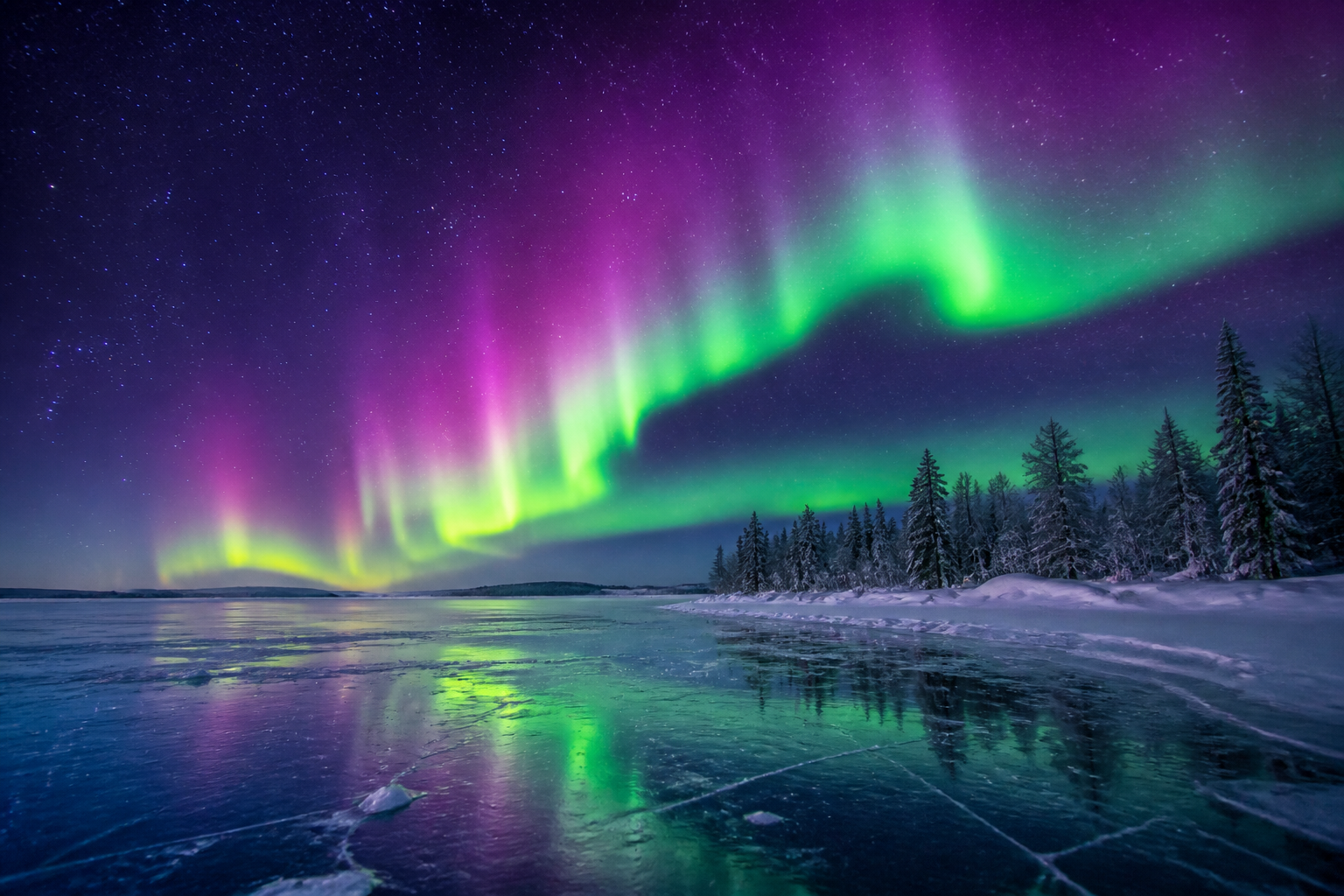
When we talk about the Northern Lights, we often talk about luck. And while it’s true you need the sun to cooperate, the other half of the equation is much closer to home: the weather. A sky full of dancing aurora is useless if it’s hidden behind a thick blanket of clouds. This is where Inari, our home, has a distinct, almost secret, advantage.
We’re located deep in the heart of northern Lapland, far from the coastal weather systems and nestled in a unique geographical pocket. This means that when other parts of Lapland are clouded over, we often enjoy crisp, clear nights. For anyone serious about aurora hunting, Inari isn't just another beautiful destination; it's a strategic choice for tilting the odds firmly in your favour.
So, Why Are Inari's Skies So Clear?
This is the question we get most often, and the answer lies in the mountains. To our west, the Kjølen mountain range runs along the border between Norway and Sweden. The prevailing winds in this part of the world travel from the west, carrying moisture from the Atlantic Ocean. As this wet air hits the mountains, it’s forced upwards, where it cools and condenses, dumping most of its snow and clouds on the Norwegian side.
By the time this air mass crosses the mountains and descends into our region around Inari, it's significantly drier. We live in the “weather shadow” of the Scandinavian mountains. This gives us a drier, more stable continental climate compared to the coastal areas. While it can get incredibly cold here, that cold is often accompanied by the perfectly still, clear skies that every aurora hunter dreams of. It’s a simple piece of geography that has a massive impact on your chances of seeing the lights.
When to Go: The Aurora Season in Inari
While the aurora is technically active year-round, you need darkness to see it. Our season for aurora hunting in Inari runs from late August until early April.
September – October (Autumn Auroras): This is a beautiful and underrated time. The crowds are smaller, and the landscape is painted in gorgeous autumn colours ('ruska'). Most importantly, Lake Inari and the surrounding rivers are still open water, giving you the chance to see the aurora reflected on the surface—a truly magical double display. Temperatures are more manageable, often hovering around 0°C to -10°C at night.
November – January (Polar Night Magic): Welcome to 'kaamos', the polar night. From late November to mid-January, the sun doesn’t rise above the horizon. This means more hours of darkness and a larger window for potential sightings. It is, however, the coldest period. Expect temperatures to regularly drop below -25°C. The landscape is a pristine wonderland of deep, soft snow.
February – March (The Prime Time): This is often considered the best of both worlds. The nights are still long and dark, but the sun returns, giving you daylight hours for other activities like skiing or husky sledding. Statistically, solar activity tends to spike around the spring equinox in March. The snowpack is at its thickest, and the cold, while still intense, can feel a little less biting than in January. This is peak season, so book everything well in advance.
Our Favourite Aurora Viewing Spots in Inari
Getting away from the village lights is key. Even the small amount of light pollution from Inari village can dim a faint display. Here are a few of our go-to spots:
The Shores of Lake Inari: As a massive body of water (the third-largest in Finland), Lake Inari offers a vast, unobstructed northern horizon. In winter, you can walk out onto the frozen, snow-covered lake for a completely open view of the sky. Just be sure you go with a guide or stick to marked/well-trodden paths. A quiet spot near the old Pielpavuono Church can be fantastic.
The Juutua River: The river flows right through Inari village and offers some easily accessible dark spots. A short walk upstream or downstream from the main bridge can be enough to find a great vantage point, with the open water creating beautiful foregrounds for photos.
On a Hilltop: For a panoramic 360-degree view, heading up a local fell is a great option. Tuulispää Fell, a short drive from the village, offers a stunning perspective over the entire region. It will be windier and colder up there, so be prepared.
A Wilderness Clearing: One of the best ways to see the lights is to head into the forest with a guide who knows the local clearings and frozen mires. Here, you are completely enveloped by the silence of the Arctic night, with nothing but the snow, the trees, and the sky.
Guided Aurora Tours vs. DIY Hunting
This is a classic trade-off between cost and convenience.
Guided Aurora Tours are our strong recommendation for first-timers. The local guides are experts at reading a dozen different weather forecasts and aurora apps to find pockets of clear sky. They know the safe backroads and have access to private wilderness camps.
- Types & Prices:
- Minibus Chase: You'll drive to wherever the forecast is best. Comfortable and warm. Costs around €100 - €160 per person for a 3-4 hour tour.
- Snowmobile Safari: More adventurous. You drive your own snowmobile deep into the wilderness. A thrilling experience. Costs €160 - €250 per person.
- Reindeer or Husky Sleigh: A slower, more traditional, and silent way to experience the night. Less about chasing and more about enjoying the atmosphere. Prices vary from €150 - €220.
DIY Aurora Hunting gives you freedom but comes with responsibility. You'll need to rent a car (with good winter tires!), monitor the aurora and weather apps yourself (we like 'My Aurora Forecast' and 'Ventusky'), and know where you're going. It's rewarding when it pays off, but you can also spend a cold night waiting under a cloudy sky. A car is essential; you can't just walk out of town into a good spot. Remember that phone batteries die very quickly in the extreme cold, so don't rely on them for navigation.
What to Wear: The Non-Negotiable Gear List
There's no such thing as bad weather, only bad clothing. We cannot stress this enough. Being cold will ruin your experience. The secret is layering.
- Base Layer: Merino wool long johns and a long-sleeved shirt. Do not wear cotton. It holds moisture and makes you cold.
- Mid-Layer: A thick fleece or wool sweater. You can add a second mid-layer if you tend to get cold.
- Outer Layer: A thermal, windproof, and waterproof snowsuit or overalls/parka combo. Most tour operators offer these for rent for around €20-€35 per day, and it's absolutely worth it.
- Feet: Two pairs of socks. A thin merino liner and a thick wool sock. Your boots should be insulated, waterproof, and at least one size bigger than your normal shoes to allow for air circulation.
- Hands: A thin pair of liner gloves for operating your camera, with a huge pair of insulated mittens to go over them.
- Head: A warm wool or fleece hat that covers your ears, plus a buff or balaclava to protect your face from the wind. Chemical hand and toe warmers are a fantastic local trick!
Simple Camera Settings for Capturing the Aurora
You don't need to be a pro, but a smartphone won't capture the aurora well unless it's a very strong display. For a dedicated camera:
- Must-haves: A camera with manual mode (DSLR or mirrorless), a lens that can open wide (e.g., f/2.8 or lower), and a sturdy tripod. A flimsy tripod will vibrate in the wind and blur your shot.
- Focus: Set your lens to Manual Focus (MF). Turn on Live View, zoom in on the brightest star you can find, and adjust the focus ring until it's a sharp pinpoint. Then, don't touch it again.
- Settings:
- Mode: Manual (M).
- Aperture (f-stop): Set it to the lowest number your lens allows (e.g., f/1.8, f/2.8, f/4).
- ISO: Start at 1600 or 3200.
- Shutter Speed: This depends on the aurora's brightness and speed. For a faint, slow-moving arc, try 15-25 seconds. For a fast-dancing, bright corona, try 3-8 seconds to capture the detail.
Pro Tip: Bring 2-3 fully charged batteries and keep the spares in a warm inside pocket close to your body. The cold will drain them in minutes.
Beyond the Lights: What Else We Do in Inari
Your days are just as important as the nights! Inari is the heart of Sámi culture in Finland, and you can't leave without experiencing it. For a complete overview of planning your trip, check out our Inari Finland travel guide. To make the most of your visit, consider these other things to do in Inari. For even more detailed information on seeing the lights, check out our ultimate Northern Lights Inari guide.
- Visit Sámi Museum and Nature Centre Siida: This is non-negotiable. It's a world-class museum that tells the story of the Sámi people and the arctic environment. Plan at least 3 hours here. The entrance fee is around €15.
- Meet the Reindeer: This isn't just a tourist activity; reindeer herding is a cornerstone of Sámi life. A visit to a local farm offers a genuine cultural connection.
- Go Ice Fishing: Join a local on the frozen Lake Inari, drill a hole through the ice, and wait patiently for a perch or grayling. It’s a lesson in arctic silence. You can learn more in our Ultimate Guide to Ice Fishing in Lapland.
- Hike to the Pielpajärvi Wilderness Church: A beautiful 10km round-trip hike or ski through the woods leads to one of the oldest buildings in the region. It's a truly peaceful journey.
Practical Questions about Aurora Hunting in Inari
Book your Lapland trip
- 🚗 Drive — Compare rental cars for Lapland winter roads
- 🦌 Do — Browse husky, reindeer and aurora tours
- 🏨 Stay — Compare hotels, cabins and glass igloos in Lapland
Some links on this page are affiliate links. Booking through them costs you nothing extra and helps keep Lapland Buddy free.
Frequently asked questions
What's the real chance of seeing the aurora in Inari?
Honestly, it's very high, but never 100% guaranteed. If you stay for 3-4 nights between September and March and are proactive about hunting (either with a guide or by yourself on clear nights), your chances are probably in the 80% range. Inari's clear skies give you a huge advantage.
Do I need to book aurora tours in advance?
Absolutely, yes. Especially if you're visiting between December and March. The best local guides are small operations that get booked up months in advance. We recommend booking your accommodation and main activities at the same time.
Is Inari better than Rovaniemi for aurora hunting?
For pure aurora hunting, yes. Rovaniemi is a fantastic city and home to the magical [Santa Claus Village](/place/santa-claus-village), but it is further south, which means the aurora is statistically less frequent. It also has more light pollution and cloud cover. We tell people: go to Rovaniemi for the Christmas magic, come to Inari for serious aurora hunting.
How cold does it actually get?
It can get very cold. Temperatures of -25°C to -35°C (-13°F to -31°F) are common in mid-winter. The air is very dry, so it doesn't always feel as biting as a damp cold, but it's a cold that cannot be ignored. With the right layers, which you can rent, it is perfectly manageable and part of the experience.
Can I see the aurora from my hotel window?
It's possible if the aurora is extremely strong and your accommodation is on the edge of the village with a clear northern view. However, you will always get a much better, more vibrant, and darker-sky experience by getting just a 5-10 minute drive away from the village lights.