Päiväkirja
Northern Lights Inari: An Ultimate 2026-2027 Aurora Guide
Far north of the Arctic Circle, Inari offers some of the world's most spectacular Northern Lights viewing—here's our complete guide to making it happen.
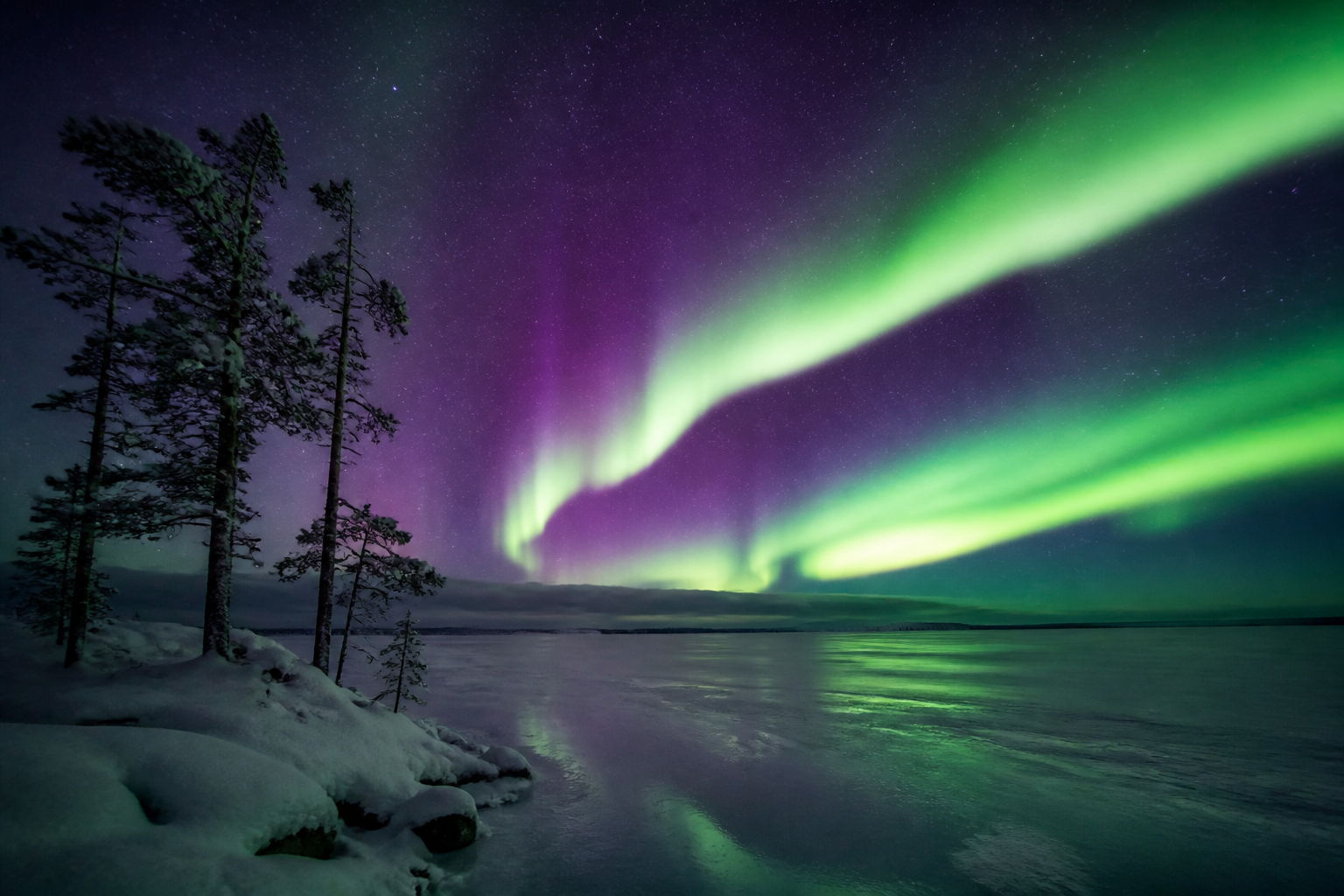
Here in Lapland, we talk about the Northern Lights in hushed tones. They’re not just a light show; they’re an ancient, mystical part of our arctic life, known as revontulet, or 'fox fires'. And if you want to experience them in their purest, most powerful form, we’ll let you in on a local secret: head north. Far north, to Inari.
Forget the bustling resorts for a moment. Inari is different. This is the heartland of the Sámi people, a place defined by the immense, frozen expanse of Lake Inari and skies so dark and vast they feel infinite. Here, the aurora isn't just something you hope to see; it’s a constant, silent presence waiting for the right moment to dance. We've spent countless nights under these skies, and we want to share how you can, too.
Why Inari for the Aurora? The Northern Advantage
First things first: why travel all the way to Inari? Location, location, location. Inari sits at a latitude of 68.9° North, placing it directly under the "auroral oval"—a permanent ring of aurora activity circling the geomagnetic pole. This means that even on nights with minimal solar activity, you have a higher chance of seeing something shimmering on the horizon compared to locations further south.
The second reason is the landscape. The region is dominated by Lake Inarijärvi, the third-largest lake in Finland. In winter, it transforms into a massive, flat, white desert of ice and snow, offering perfectly unobstructed 360-degree views of the sky. There are no mountains blocking your view, no city glow polluting the horizon. It’s just you and the cosmos. This combination of prime latitude and pristine nature makes Inari one of the most reliable and breathtaking aurora destinations on the planet.
When to See the Northern Lights in Inari: A Seasonal Breakdown
The aurora season in Inari runs from late August to early April, but the experience changes dramatically with the months.
- September – October (The "Ruska" Season): This is a magical time. The autumn colours (ruska) are fiery, and the lakes haven't frozen yet. This means you can see the Northern Lights reflected in the dark, open water—a photographer's dream. Temperatures are milder, often hovering around 0°C to -10°C at night, making the waiting game much more comfortable.
- November – January (The Polar Night or "Kaamos"): This is the heart of winter. The sun doesn't rise above the horizon for weeks, bathing the landscape in a mystical blue twilight for a few hours a day. With nearly 20 hours of true darkness, your window for aurora hunting is huge. This is when you'll experience the deep, crisp cold of the Arctic, with temperatures regularly dropping to -20°C or even -35°C. The snow is deep, the silence is profound, and the aurora feels electrifying against the profound darkness.
- February – April (The Spring-Winter): The light returns. Days get progressively longer and sunnier, but the nights remain dark and cold enough for spectacular shows. The snow cover is at its thickest, perfect for activities like snowmobiling or snowshoeing out to a viewing spot. Statistically, the weeks around the spring equinox (in March) often see a spike in geomagnetic activity, leading to some of the most intense auroras of the year.
Buddy's Tip: Don't just aim for mid-winter. The shoulder seasons of September and March offer a fantastic balance of high aurora probability and more manageable conditions.
Top Spots for Aurora Hunting Around Inari
You don't always need a complex tour. Some of the best spots are accessible on your own.
- Walking from Inari Village: The light pollution in Inari village is minimal, but walking just 10-15 minutes makes a huge difference. Head out of the village center towards the Juutuanjoki River. The bridge over the rapids is a popular spot. For an even darker sky, walk along the road past the Siida Museum & Nature Centre.
- The Shore of Lake Inari: This is the classic choice. Find a safe spot along the shore where you have a clear view to the north. In winter, you can walk out onto the frozen lake (stick to marked paths or areas you know are safe!), lie down on a reindeer hide, and just watch the sky.
- Utsjoki Road (E75 North): If you've rented a car, driving 15-30 minutes north from Inari towards Utsjoki will take you into true wilderness. There are numerous small parking lay-bys where you can safely pull over. The landscape opens up, and you'll be completely alone with the sky. Just be careful of reindeer on the road!
Guided Northern Lights Tours: Are They Worth It?
For many, a guided tour is the best way to maximize their chances and comfort. Here’s the honest breakdown for the 2026-2027 season.
- Aurora Chasing by Minibus/Car: This is our top recommendation for serious aurora hunters. Guides are experts at reading weather patterns and will drive hundreds of kilometers if needed to find a clear patch of sky. They know all the secret spots.
- Cost: Around €110 - €160 per person for a 4-hour tour.
- Includes: Hotel pickup, expert guide, warm overalls, hot drinks, and often a campfire snack.
- Snowmobile Aurora Tour: This is about the adventure as much as the aurora. You'll drive through silent, snowy forests and onto frozen lakes to find a viewing spot. It's an incredible thrill.
- Cost: Around €160 - €250 per person (2 people per snowmobile).
- Trade-off: You're less mobile than a car, so if the weather is cloudy locally, you're stuck.
- Aurora Snowshoeing or Skiing: A gentle and silent way to experience the arctic night. You won’t go far, but the experience of moving through the hushed forest under the moonlight (and hopefully the aurora) is unforgettable.
- Cost: Around €90 - €130 per person.
- Husky or Reindeer Sleigh Aurora Tour: These are more about the animal experience with a chance of aurora, rather than a dedicated hunt. They are slower and cover less ground, but the romance factor is off the charts.
Our Verdict: Yes, a guided tour, especially a minibus chase, is worth the investment for your first couple of nights. The local knowledge is invaluable.
DIY Aurora Hunting: Our Local Tips
Want to go it alone? We respect that! It’s incredibly rewarding.
- Rent a Car: This gives you the ultimate freedom. Book in advance, especially for the peak season. All rental cars in Lapland come equipped with winter tires (it's the law). Drive slowly and watch for ice.
- Use the Right Apps: Don't rely on generic weather apps. Use the Finnish Meteorological Institute's "Auroras Now!" website for real-time magnetic activity in Finland. For forecasts, we use apps like My Aurora Forecast and the website SpaceWeatherLive.com. Remember, a high KP index isn't everything; you need clear skies!
- Pack a "Go-Bag": Have a backpack ready with a thermos of hot juice (glögi is our favourite), some snacks, a fully charged phone, a power bank, and a headlamp with a red-light setting to preserve your night vision.
How to Photograph the Aurora (Without a Fancy Degree)
You’ve waited for this moment—don't miss the shot!
- A Tripod is Essential. We cannot stress this enough. You will be using long shutter speeds, and any camera shake will result in a blurry mess. No exceptions!
- Camera Settings: Switch to Manual Mode (M).
- Aperture: Set it as wide as possible (the lowest f-number, like f/1.8, f/2.8, or f/4). This lets in the most light.
- Shutter Speed: Start with 10 seconds. If the aurora is bright and moving fast, try 3-5 seconds. If it's faint, you might need 15-25 seconds.
- ISO: Start around 1600. If your picture is too dark, raise it to 3200. Try not to go much higher, or the image will become grainy.
- Focus: Switch to manual focus. Aim at a very distant star or the moon and set your focus. Then don't touch it again! Using tape to fix the focus ring is a pro-tip.
- Phone Photography: Modern phones have excellent Night Modes that can capture the aurora! The key is still to keep the phone perfectly still. Use a small phone tripod or prop it up securely on your bag or a rock.
Buddy's Tip: Keep your spare batteries in a warm pocket close to your body. The extreme cold drains them in minutes.
What to Wear: The Secret to Staying Warm at -30°C
There's no bad weather, only bad clothing. This is the mantra we live by. To stay warm for hours while standing still, you need to dress smarter, not just bigger.
- Layer 1 (Base): Merino wool long underwear (top and bottom). It wicks moisture away and stays warm even if you sweat a little. Never wear cotton.
- Layer 2 (Mid): A thick fleece sweater and fleece-lined trousers. A lightweight down or synthetic puffy jacket can also be a great mid-layer.
- Layer 3 (Outer): A high-quality, insulated, windproof, and waterproof parka and ski pants. Many tour operators provide these, but having your own is a good idea.
- Extremities: This is where the cold gets you.
- Feet: One pair of thick merino wool socks inside well-insulated winter boots (rated to at least -30°C).
- Hands: Thin liner gloves underneath thick, insulated mittens. Mittens are much warmer than five-fingered gloves.
- Head: A warm hat (beanie) that covers your ears, plus a balaclava or neck gaiter to protect your face.
Beyond the Lights: What Makes Inari Unforgettable
What if the clouds roll in? Don’t worry. A trip to Inari is about more than just the aurora.
Embrace the culture and nature. Spend a day at the Siida Museum & Sámi Nature Centre. It is, without a doubt, one of the best museums in Finland. It will give you a profound understanding of the Sámi culture and the fragile arctic environment you're visiting. For €15, it's an experience that provides context to everything you see outside.
You can also go dog sledding during the day, visit a local reindeer farm to learn about herding, or try your hand at ice fishing on the great Lake Inari. The beauty of the polar night or the bright spring-winter days is a reward in itself. The aurora is the magnificent, awe-inspiring bonus.
Practical Questions about Northern Lights in Inari
We get these questions all the time, so let's clear them up.
What are my actual chances of seeing the Northern Lights in Inari?
Honestly, they're very high if you stay for a few nights. Statistically, the aurora is visible on roughly 200 nights a year in this part of Lapland. If you stay for 3-4 nights and are actively looking (or on a tour), you have an excellent chance, provided the skies are clear. Nothing is ever 100% guaranteed, though!
Is Inari better than Rovaniemi for aurora hunting?
For purely seeing the Northern Lights, yes. Inari is significantly further north and has far less light pollution. Your odds are statistically better here. However, Rovaniemi offers more attractions, like the Santa Claus Village, and is easier to get to. It's a trade-off: Inari for raw nature and peak aurora, Rovaniemi for a broader family holiday experience.
How cold does it really get in Inari during aurora season?
It gets properly, deeply cold. In the peak of winter (December-February), temperatures of -15°C to -25°C are normal at night, and it can easily drop below -30°C. The cold is a dry cold, which is more manageable than a damp one, but it requires serious respect and the right clothing.
Do I need a guide to see the aurora in Inari?
Not strictly. If you rent a car, are comfortable driving on icy roads, and know how to check the forecasts, you can absolutely find them yourself. However, we highly recommend a guide for your first time. They remove all the guesswork, ensure your safety, and their expertise in finding clear skies is often the difference between seeing a faint glow and a full-blown corona.
Can I see the Northern Lights from my hotel window in Inari?
It's possible, especially if the aurora is strong and your room faces away from the village lights. Some hotels, like Wilderness Hotel Inari & Igloos, are built with aurora viewing in mind and even offer an aurora alarm service. However, for the best and most immersive experience, you should always make an effort to get outside and away from any artificial light.
Buddy's Take
There's a reason we send people north to Inari. It’s a journey to a quieter, more profound Lapland. Chasing the aurora here isn't about ticking an item off a bucket list. It’s about standing in the immense silence of a frozen lake, feeling the biting cold on your cheeks, and watching the sky come alive with colours you'll never forget. The aurora might be the goal, but the entire experience—the darkness, the snow, the Sámi culture, the silence—is the real reward. Be patient, dress warm, and look up. The magic will find you.
Usein kysyttyä
What are my actual chances of seeing the Northern Lights in Inari?
Honestly, they're very high if you stay for a few nights. Statistically, the aurora is visible on roughly 200 nights a year in this part of Lapland. If you stay for 3-4 nights and are actively looking (or on a tour), you have an excellent chance, provided the skies are clear. Nothing is ever 100% guaranteed, though!
Is Inari better than Rovaniemi for aurora hunting?
For purely seeing the Northern Lights, yes. Inari is significantly further north and has far less light pollution. Your odds are statistically better here. However, Rovaniemi offers more attractions, like the Santa Claus Village, and is easier to get to. It's a trade-off: Inari for raw nature and peak aurora, Rovaniemi for a broader family holiday experience.
How cold does it really get in Inari during aurora season?
It gets properly, deeply cold. In the peak of winter (December-February), temperatures of -15°C to -25°C are normal at night, and it can easily drop below -30°C. The cold is a dry cold, which is more manageable than a damp one, but it requires serious respect and the right clothing.
Do I need a guide to see the aurora in Inari?
Not strictly. If you rent a car, are comfortable driving on icy roads, and know how to check the forecasts, you can absolutely find them yourself. However, we highly recommend a guide for your first time. They remove all the guesswork, ensure your safety, and their expertise in finding clear skies is often the difference between seeing a faint glow and a full-blown corona.
Can I see the Northern Lights from my hotel window in Inari?
It's possible, especially if the aurora is strong and your room faces away from the village lights. Some hotels are built with aurora viewing in mind and even offer an aurora alarm service. However, for the best experience, you should always get outside and away from any artificial light.
Lisää kysymyksiä?
Kysy Buddylta suoraan — ilmaisia ja välittömiä vastauksia Rovaniemestä ja Lapista.
Avaa Lapland Buddy