Päiväkirja
Driving in Lapland in Winter: A Complete Safety Guide
Worried about hitting the snowy roads on your Arctic adventure? We'll show you exactly how to drive safely and confidently in a Lappish winter.
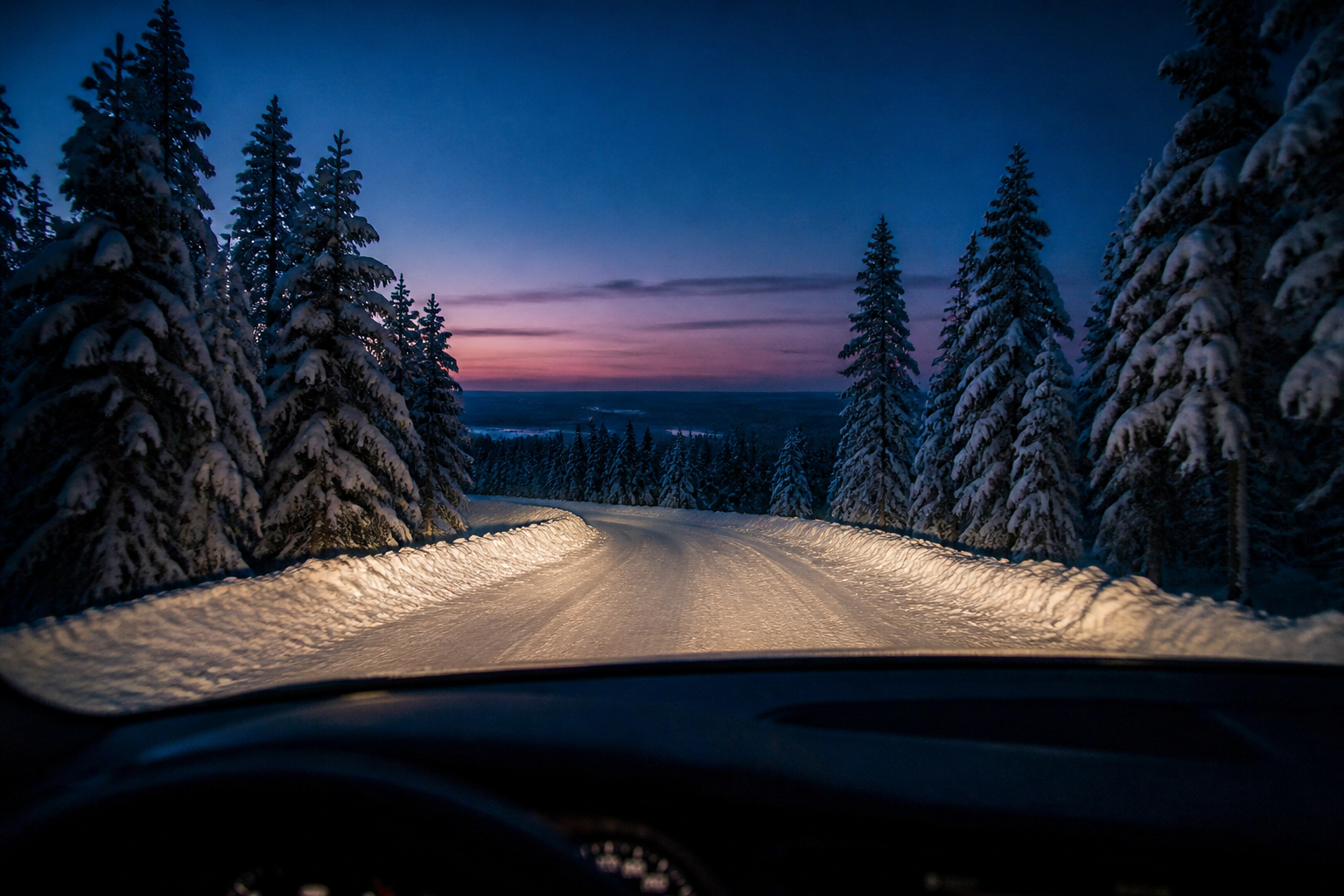
Dreaming of a winter road trip through Lapland? Picturing yourself pulling over on a quiet road to watch the Northern Lights dance, far from any crowds? It’s a magical thought, and having your own car here gives you a freedom that is simply unbeatable. You can chase the aurora, find hidden gems, and travel on your own schedule.
But we get it. The idea of driving on snow and ice, in the dark, with reindeer wandering about, can be daunting. Many visitors are nervous, and honestly, that’s a good thing! A little caution goes a long way here. The good news is that driving in a Lappish winter is much safer and easier than you might think. We’re equipped for it, and soon, you will be too. Let’s go through everything you need to know to feel confident behind the wheel.
Why Your Rental Car is Secretly an Ice-Driving Machine
Let's talk about the single most important factor for safe winter driving here: the tires. From November 1st until the end of March (and often into April), it is mandatory by law for all cars in Finland to have proper winter tires. When you rent a car here in winter, it will come equipped with studded tires, and they are game-changers.
These aren't just regular tires with deep treads. They have small metal studs embedded in the rubber that act like tiny claws, gripping into the ice on the road surface. The first time you drive on a clear patch of asphalt, you'll hear a distinct crunching, humming sound – that's the studs at work. On packed snow and ice, they provide a level of traction that is truly incredible. While you still need to be cautious, you are not driving on a slippery, unpredictable surface. You are driving with equipment specifically designed for these conditions.
Renting the Right Car for a Lappish Winter
Booking your <a href="/car-rental">rental car</a> in advance is crucial, especially if you're visiting during the peak season from December to February. Prices can soar, and availability can plummet. You can expect to pay anywhere from €60 to €120 per day for a standard compact car, depending on the season and how far in advance you book.
- Automatic is Easiest: We strongly recommend renting an automatic. It allows you to focus solely on your speed and steering, without worrying about shifting gears on a slippery surface.
- The Engine Block Heater: Your rental car will almost certainly come with a cable in the trunk or glove box. This is for the engine block heater. On very cold nights (below -10°C), you’ll find electrical posts in hotel and cottage parking lots. You plug one end into the socket on the front of your car (often hidden in the grille) and the other into the post. This keeps the engine block and cabin heater warm, making it easier to start the car and defrost your windows. Ask your rental company to show you how it works!
- Do I need a 4x4? For 95% of visitors, the answer is no. A standard front-wheel-drive car with studded tires is perfectly capable of handling the main, well-maintained roads between towns like Rovaniemi, Levi, and Saariselkä. A 4x4 offers extra confidence, especially when pulling away from a stop, but it doesn't help you brake any faster.
How to Handle Icy Roads Like a Local
The golden rule of winter driving is smoothness. Imagine you have a full, hot cup of coffee on your dashboard, and you don't want to spill a drop. Every action—braking, accelerating, and steering—should be gentle and deliberate.
- Leave Huge Gaps: The four-second rule you learned in driving school? Forget it. In winter, we use a ten-second rule. Pick a landmark and count how long it takes for you to reach it after the car in front passes it. This gives you ample time to react and brake slowly if needed.
- Look for 'Black Ice': The most dangerous ice is the ice you can't see. Black ice is a thin, transparent layer of ice that looks just like wet, dark asphalt. It often forms on bridges, overpasses, and in shaded corners where the sun doesn't reach. If the road ahead looks dark and glossy while everything else is white, be extra cautious.
- Correcting a Skid: If you feel the back of the car start to slide (oversteer), your instinct will be to slam the brakes. Don't! Take your foot off the accelerator and gently steer into the direction of the skid. If the rear of the car is sliding to the right, steer to the right. This helps the car straighten out. Modern cars with stability control (ESP) will help you immensely here.
The Reindeer Rule: Sharing the Road with Wildlife
Yes, you will see reindeer. They are a common sight along the roadsides, and sometimes, right in the middle of the road. While they are a magical part of the Lapland experience, they pose a real driving hazard.
When you see a reindeer, slow down immediately. They are herd animals, so if you see one, there are almost certainly more nearby that you haven't spotted yet. They are unpredictable and have zero road sense. Don't assume they will move out of the way. Honking your horn might work, or it might just confuse them. The best approach is to slow right down, be patient, and wait for them to move on. Moose are much rarer to see but are far more dangerous due to their size. Be vigilant, especially at dusk and dawn.
Speed Limits are a Limit, Not a Target
The default speed limit on major highways in Finland is 100 km/h in summer. In winter, this is reduced to 80 km/h on nearly all roads outside of towns. This is the absolute maximum legal speed in perfect conditions.
Nobody—and we mean nobody—drives at 80 km/h when it's actively snowing or the road is covered in slush. It is completely normal and expected to drive at 60-70 km/h if that’s what feels safe. The goal is to arrive at your destination, not to set a speed record. Don't feel pressured by the rare local who might overtake you. You are doing the right thing by driving to the conditions.
Navigating Through the Polar Night
During the heart of winter, known as 'Kaamos' or Polar Night, the sun doesn't rise above the horizon for several weeks in the northernmost parts of Lapland. This means a lot of driving in the dark. However, it's not the pitch-black void you might imagine. The snow on the ground reflects the ambient light from the sky, stars, and moon, casting a beautiful, blueish glow over the landscape.
Your rental car will have excellent headlights. Use your high beams whenever there are no oncoming cars. It is essential for spotting wildlife and curves in the road far in advance. GPS like Google Maps or Waze works reliably, but we highly recommend downloading offline maps for the region you're visiting, just in case you lose signal in a remote area.
Your In-Car Winter Emergency Kit
Your rental will have a snow brush and ice scraper. Here’s what we suggest you add or confirm is in the car before you set off on a longer drive:
- A fully charged phone and a power bank. Your phone is your lifeline.
- Warm blankets and extra layers. If you get stuck, the car will get cold fast.
- Water and snacks. Just in case you have to wait for help.
- A headlamp or torch. Essential if you have to get out of the car in the dark.
- A high-visibility vest. It's legally required to have one in the car and you should wear it if you have to step onto the road in an emergency.
- The '112 Suomi' app. This is Finland's official emergency app. When you call for help through the app, it automatically sends your exact GPS coordinates to the dispatcher.
The Half-Tank Rule: Fueling Up
Once you leave larger towns like Rovaniemi, petrol stations can be few and far between, especially as you head further north towards Inari or Utsjoki. We live by the half-tank rule: when your fuel gauge hits the halfway mark, start looking for the next station.
Many stations in rural areas are unstaffed 'cold stations' (kylmäasema). You pay at the pump before you fill up using a credit or debit card with a chip and PIN. They do not typically accept cash or cards that require a signature. It's a good idea to inform your bank of your travel plans to avoid any issues.
Frequently Asked Questions
Thinking of where to stay? You can <a href="/go/booking/booking-generic?ctx=eyJwcm92aWRlcl9zbHVnIjoiYm9va2luZyIsInByb3ZpZGVyX3R5cGUiOiJob3RlbCIsImRlc3RpbmF0aW9uX25hbWUiOiJMYXBsYW5kIiwiY2l0eSI6IkxhcGxhbmQiLCJjaGVja19pbiI6bnVsbCwiY2hlY2tfb3V0IjpudWxsLCJhZHVsdHMiOm51bGwsImNoaWxkcmVuIjpudWxsLCJjdXJyZW5jeSI6IkVVUiIsInNvdXJjZV90eXBlIjoiYmxvZ19hZmZpbGlhdGUiLCJzZXNzaW9uX2lkIjpudWxsLCJmYWxsYmFja191cmwiOiJodHRwczovL3d3dy5ib29raW5nLmNvbS9zZWFyY2hyZXN1bHRzLmh0bWw_c3M9TGFwbGFuZCZub19yb29tcz0xJnNlbGVjdGVkX2N1cnJlbmN5PUVVUiJ9">check hotel availability in Lapland</a> here. For a comprehensive guide on staying safe on the roads, check out our full driving in Lapland winter safety guide.
--- END ---
Book your Lapland trip
- 🏨 Stay — Compare hotels, cabins and glass igloos in Lapland
- 🚗 Drive — Compare rental cars for Lapland winter roads
- 🦌 Do — Browse husky, reindeer and aurora tours
Some links on this page are affiliate links. Booking through them costs you nothing extra and helps keep Lapland Buddy free.
--- END ---
Usein kysyttyä
Do I need a 4x4 or SUV to drive in Lapland in winter?
For most tourists, no. A standard front-wheel-drive car is perfectly fine for the main roads, which are well-maintained. All rental cars come with excellent studded winter tires, which are more important than four-wheel drive. A 4x4 can offer more confidence but isn't a necessity.
Are all roads in Lapland kept clear of snow?
The main arteries and highways connecting towns are plowed very regularly and efficiently. Smaller, private roads to cottages or more remote areas may not be cleared as quickly. If you are a nervous driver, it's best to stick to the primary and secondary roads, which are always in good condition.
Do I need an International Driving Permit (IDP) for Finland?
If your license is issued in a European Union or Nordic country, you do not need an IDP. Licenses from countries that are part of the Geneva or Vienna Road Traffic Conventions (like the US, Canada, Australia, and UK) are also generally accepted for tourists. However, it's always wise to check with your specific rental car company for their policy, as having an IDP can sometimes simplify the process.
What's the biggest mistake tourists make when driving in winter?
The most common mistakes are driving too fast for the conditions and following the car in front too closely. People see the 80 km/h speed limit and think they must drive that fast, but local conditions often require a much slower, safer speed. Always leave a very generous following distance.
Can I look for the Northern Lights while driving?
Absolutely not. This is extremely dangerous. The driver must always focus on the road. If the aurora appears, find a safe, designated parking area or a safe spot to pull completely off the road before you start watching the sky. Distracted driving is a major risk, especially in winter.