Journal
Best Northern Lights App Lapland: Our 2026-2027 Field Test
Stop guessing and start seeing—we tested the best Northern Lights apps in Lapland to find out which one truly delivers on its promises for the 2026-2027 season.
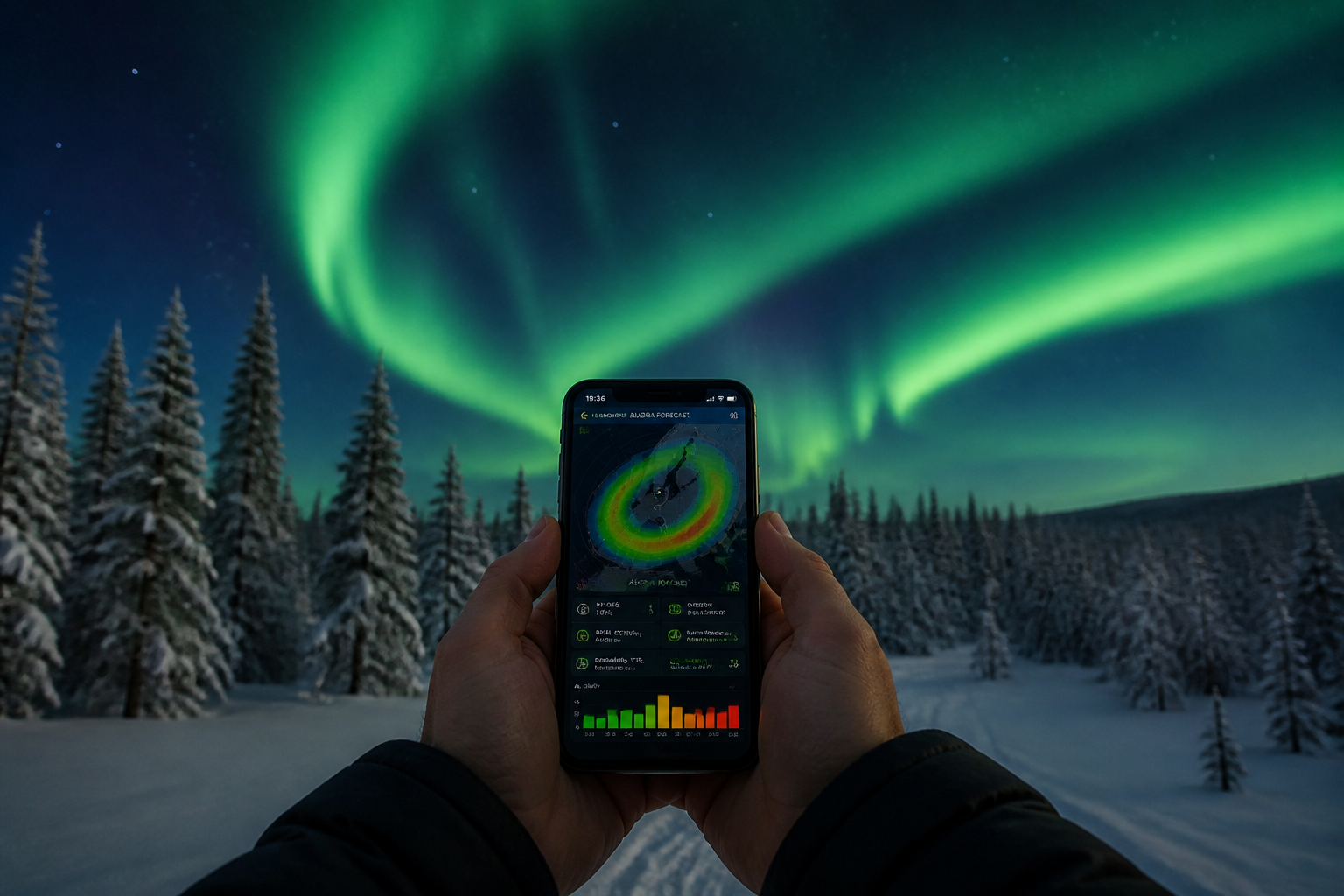
There’s a unique silence that falls over Lapland when you’re waiting for the Northern Lights. You’re bundled up, the snow is squeaking under your boots, and every flicker of a star makes your heart jump. But the biggest question floating in the frosty air is always: will they show up tonight? For years, seeing them was a game of luck, patience, and local hearsay.
Now, thankfully, we have technology in our frozen pockets. A good aurora forecast app can be the difference between a magical night and a long, cold wait for nothing. But with so many apps promising the world, which one actually works here in the north of Finland? We spent the last aurora season putting the top contenders to the test, so you can spend less time staring at your phone and more time staring at the sky.
Before the Apps: Understanding the Basics of Aurora Hunting
First, let's get one thing straight: no app can make the Northern Lights appear. It’s a tool, not a magic wand. To see the aurora, you need three ingredients to come together perfectly:
- Darkness: The season for aurora hunting in Lapland runs from late August to early April. The key is a truly dark sky, which is why the 24-hour daylight of summer (the Midnight Sun) makes it impossible. You also need to get away from the light pollution of cities like Rovaniemi or ski resorts like Levi.
- Clear Skies: This is our biggest nemesis in Lapland. The most powerful solar storm in history won't be visible if there's a thick blanket of clouds. An app can promise a huge light show, but you always need to cross-reference it with a reliable weather forecast.
- Solar Activity: This is where the apps come in. The aurora is caused by charged particles from the sun hitting our atmosphere. The apps measure this activity and predict the likelihood of a visible display.
What's a Kp-Index? The Only Number You Really Need to Know
When you open an aurora app, you'll be bombarded with data, but the most important number for beginners is the Kp-index. It’s a simple scale from 0 to 9 that measures geomagnetic activity.
Here’s how we think about it in Lapland, in simple terms:
- Kp 0-1: Don't get your hopes up. It’s quiet out there. Time to enjoy a sauna.
- Kp 2: Possible, but faint. If you’re far north in a place like Utsjoki with perfectly clear skies, you might see a pale green arc on the northern horizon.
- Kp 3: This is the magic number for a decent chance. You could see a nice, clear display, maybe even with some movement. It's definitely worth getting dressed and going outside for.
- Kp 4-5: Now we're talking! This is a strong display. Expect bright colours, visible movement (what we call 'dancing'), and a show that can cover a large part of the sky. These are the nights you’ll remember forever.
- Kp 6+: A geomagnetic storm. This is rare and spectacular. The lights can be directly overhead, with reds and purples mixing in with the greens. Your phone will be buzzing with alerts, and so will every local guide in Lapland!
Buddy's Tip: Don't get obsessed with Kp alone. A Kp 3 under a clear sky is a hundred times better than a Kp 6 with total cloud cover.
App #1: My Aurora Forecast & Alerts – The People's Champion
This is probably the most popular and well-known aurora app, and for good reason. It's our go-to recommendation for most visitors to Lapland because it strikes the perfect balance between user-friendly design and useful information.
- The Good: The main screen gives you a simple percentage chance of seeing the lights from your current location, along with the current Kp-index. The 'Aurora Map' is fantastic, showing the predicted strength of the aurora oval over the globe. The best feature, however, is the push notifications. You can set it to alert you when the viewing probability hits a certain level in your area. This means you can be warm inside and the app will tell you when it's time to go out.
- The Not-So-Good: The free version has ads, which can be a little annoying. We've also found its predictions can sometimes be slightly optimistic. It might send an alert for a Kp 3 that ends up being a very faint, brief display. But we’d rather have a false alarm than miss a show entirely.
- Price: Free with ads. The Pro version is a one-time purchase of around €10.99 and is well worth it for a once-in-a-lifetime trip. It removes ads and gives you more customisation over alerts.
App #2: SpaceWeatherLive – For the Data Lovers
If My Aurora Forecast is a friendly tour guide, SpaceWeatherLive is the university professor. It's less about a simple 'yes' or 'no' and more about giving you all the raw data so you can make your own informed decision. This is the app we serious aurora hunters use.
- The Good: It's incredibly detailed and pulls data directly from NOAA and other space weather sources, making it highly accurate. Instead of just Kp, it gives you real-time graphs for solar wind speed, density, and, most importantly, the Bz value. A southward Bz (negative number) is the secret ingredient for a strong show, as it allows solar particles to connect with Earth's magnetic field more easily. The app is completely free with no ads.
- The Not-So-Good: The interface can be intimidating for a beginner. All the graphs and acronyms can feel like overkill if you just want to know whether to put your snowsuit on. The alert system isn't as location-specific as My Aurora Forecast.
- Price: Free. A truly amazing resource maintained by the community.
Buddy's Tip: On SpaceWeatherLive, watch the Bz graph. If you see it dip sharply into the negative (below -5nT) and stay there, get your camera ready. That's a huge indicator that things are about to kick off.
App #3: Aurora Alerts – The Finnish Local
This app is a bit of an underdog, but it has a loyal following here in Finland. Developed by a Finnish aurora enthusiast, it offers a simple, no-fuss approach with a local touch.
- The Good: Its simplicity is its strength. It focuses on just a few key metrics and provides clear, easy-to-understand alerts. The user interface is clean. Its biggest advantage is the crowd-sourced sightings feature. Users can report when they see the aurora, which gives you real-time, on-the-ground confirmation that the lights are active near you—something a global forecast can't always do.
- The Not-So-Good: It has a smaller user base than the global apps, so the crowd-sourced data might be sparse if you're in a very remote area. The forecasting model isn't as powerful as the bigger apps.
- Price: The app uses a subscription model, which is around €2.99/month or €14.99/year. You can try it for free to see if you like it.
How We Tested: Our Night Out Near Saariselkä
To give these apps a fair shake, we took them out for a field test on a clear night in January. We set up our base near Saariselkä, far from any light pollution. If you're planning your own trip, remember to check hotel availability in Lapland.
Around 9 PM, My Aurora Forecast buzzed first: “Potential for auroras in your area in the next hour.” Kp was forecast to hit 3. At the same time, we checked SpaceWeatherLive. We saw the solar wind speed was stable, but the Bz value was starting to dip southwards. Promising!
Sure enough, around 9:45 PM, a faint green band appeared on the northern horizon. A few minutes later, Aurora Alerts sent a notification: “User in Ivalo reports visible aurora.” This confirmed what we were seeing. Over the next hour, the band brightened and started to show some vertical pillar structures—a classic Kp 3 display. My Aurora Forecast did its job perfectly for the casual observer, while SpaceWeatherLive gave us the confidence to wait it out, knowing the underlying conditions were right.
The Verdict: The Best Northern Lights App for Most Lapland Visitors
After extensive use throughout the 2025-2026 season, our clear recommendation for the average visitor to Lapland is My Aurora Forecast & Alerts.
It provides the best combination of a user-friendly interface, reliable and location-aware push notifications, and good-enough accuracy. For the price of a hot chocolate, the Pro version offers a seamless experience that genuinely increases your chances of seeing the lights. It tells you when to look up, and that’s exactly what most people need.
For the serious photographer or aurora enthusiast who wants to understand the science, we recommend using SpaceWeatherLive in combination with My Aurora Forecast. Use My Aurora for the simple alerts and SpaceWeatherLive to dig into the data and predict if a small event could turn into a major storm.
A Word on Cloud Cover: The App Feature Everyone Forgets
We have to say this one more time: clouds are the number one dream-killer. A Kp-index of 7 means nothing if you can't see the sky. While some aurora apps have a cloud cover layer, we find them to be mediocre at best.
Your aurora app should always be used with a dedicated weather app. We locals often use two: Yr.no (from the Norwegian Meteorological Institute) and Foreca (a Finnish company). Check their cloud cover forecasts for your specific location. If you see a 2-hour window of clear skies predicted for 11 PM, and your aurora app is forecasting a Kp 3, that’s your moment to get out there! Make sure to browse Lapland activities to find the best aurora hunting experiences.
Practical FAQ for Aurora Apps in Lapland
Book your Lapland trip
- 🏨 Stay — Compare hotels, cabins and glass igloos in Lapland
- 🦌 Do — Browse husky, reindeer and aurora tours
Some links on this page are affiliate links. Booking through them costs you nothing extra and helps keep Lapland Buddy free.
--- END ---
Frequently asked questions
Can I see the Northern Lights with a low Kp-index in Lapland?
Yes, absolutely. In northern parts of Finnish Lapland, like near Utsjoki or Kilpisjärvi, you are already under the aurora oval. On a very clear, dark night, you can often see a faint green arc on the horizon even with a Kp of 1 or 2. The apps might say 'low chance', but always trust your eyes!
Are the paid versions of these apps worth it for my trip?
For a trip that you might only take once in your life, we believe so. For around €10-€15, you remove distracting ads and, more importantly, get faster, more customisable push notifications. That small investment can be the very thing that gets you outside at the exact right moment.
When is the best time of year to use these apps in Lapland?
The aurora season runs from late August to early April. The best times are around the equinoxes (September-October and February-March) as solar activity tends to be higher. However, any time you have full darkness (from roughly 4 PM to 9 AM in deep winter) and clear skies is a good time to be watching your app.
Do these apps drain my phone battery in the cold?
Yes, all phone batteries suffer in the Lappish cold. An aurora app running in the background, using GPS, will drain it even faster. Our number one tip: keep your phone in an inside jacket pocket, close to your body. And always, always carry a fully charged portable power bank with you.
Can I rely only on an app to see the aurora?
No. The apps are fantastic tools for forecasting, but they are not a substitute for patience and being prepared. Use the app to decide *when* to go out, but remember that the best way to see the lights is to be outside, away from city lights (even the glow from [Santa Claus Village](/place/santa-claus-village) can be too much), and looking up. Joining a guided tour also helps, as local guides have years of experience reading the sky and the forecasts.