Päiväkirja
Cross-Country Skiing in Lapland: A Local's Guide
Glide through silent, snow-covered forests and discover why cross-country skiing is the true soul of winter in Finnish Lapland with our local guide.
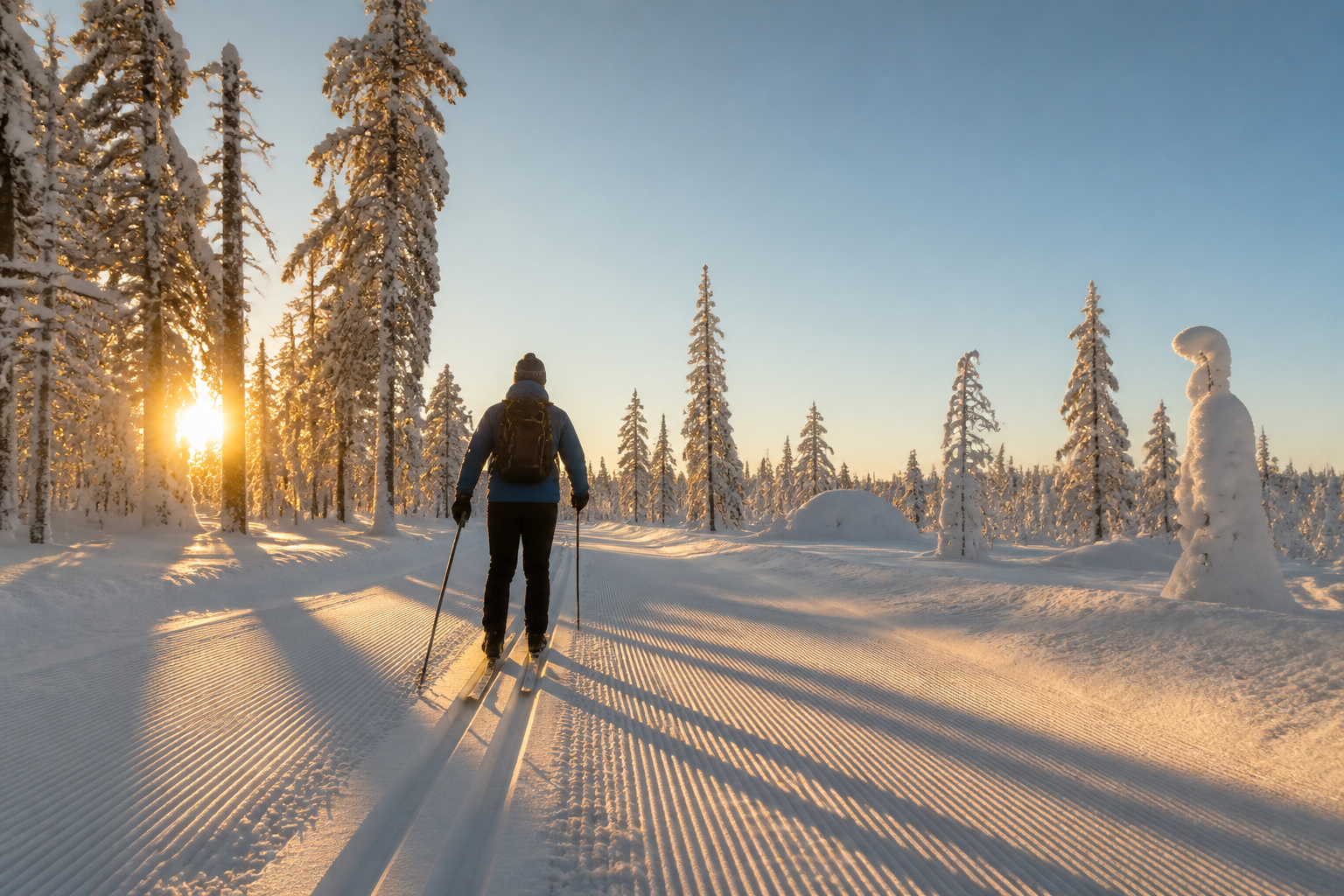
Here in Lapland, we have a saying: we are born with skis on our feet. While that might be a slight exaggeration, it gets to the heart of a truth we locals hold dear. Long before snowmobiles and ski lifts, there was just the quiet whoosh of skis gliding over snow. This is the sound of our winter, the rhythm of the forest, and the most authentic way to connect with the arctic wilderness.
Forget the crowded slopes and lift queues for a day. Cross-country skiing, or hiihto as we call it, isn't just a sport here—it's a form of moving meditation. It's about finding your pace, breathing in the world's cleanest air, and earning that hot berry juice and doughnut at a trailside cafe. It's accessible, affordable, and it’s the real Lapland. Let us show you how to get started.
Why Cross-Country is Lapland's Winter Soul
Downhill skiing is fun, no doubt. But it’s a resort experience. Cross-country skiing is a nature experience. It’s the difference between listening to a concert and walking through the woods where the music is made. On a pair of skinny skis, you can access hundreds, even thousands, of kilometres of silent trails that wind through ancient forests, over frozen lakes, and across windswept fells. You'll see reindeer, hear nothing but your own breathing, and feel a sense of peace that’s hard to find anywhere else. For us, it's how we de-stress, exercise, and visit friends in the next village over.
Classic vs. Skating: Finding Your Style
When you rent gear, they'll ask you: "Classic or skating?" Here’s the simple breakdown.
- Classic Style: This is the traditional technique and what we strongly recommend for all beginners. You ski inside two parallel, machine-groomed tracks. The motion is a gliding kick-and-glide, similar to walking or shuffling. The skis have a special 'kick zone' under your foot that grips the snow, allowing you to push forward. It’s intuitive, energy-efficient, and perfect for enjoying the scenery.
- Skating Style: This is a more modern, athletic technique that looks like ice skating. You use shorter skis and ski on the flat, groomed corduroy lane next to the classic tracks. It's faster and a more intense workout, but it requires better balance and technique.
Buddy's Tip: Don't be a hero. Start with classic. Master the basic glide and you'll have a wonderful time. Trying to skate on day one often ends in frustration and a lot of time spent in the snow.
Lapland's Top Cross-Country Ski Networks
Not all trail networks are created equal. We have a mind-boggling 2,000+ km of maintained trails in the main resort areas alone. Here’s where we love to ski:
- Ylläs: The undisputed champion. With over 330 km of trails, Ylläs is a cross-country skier's paradise. The network connects the two villages of Äkäslompolo and Ylläsjärvi, winding through the stunning Pallas-Yllästunturi National Park. The best part? The legendary trailside cafe network. You’re never more than a few kilometres from a warm hut with a fireplace. Trade-off: Its sheer size can be intimidating for a total beginner.
- Levi: The All-Rounder. Levi Ski Resort boasts a fantastic 230 km network. Many trails around the village centre are illuminated, making it perfect for an evening ski after the sun goes down (which is early in mid-winter!). The terrain is varied, with gentle loops for beginners and challenging fell routes for experts. Trade-off: Can be busier than Ylläs, especially on the trails closest to the village.
- Saariselkä: The Wilderness Gateway. Further north, Saariselkä offers about 200 km of trails, many of which venture deep into the magical Urho Kekkonen National Park. The scenery here feels wilder and more remote. You’re skiing on the edge of the vast arctic taiga. Trade-off: The weather can be more extreme, and services are more spread out.
- Rovaniemi: The City Escape. If you're staying in Rovaniemi, you don't have to go far. The Ounasvaara Outdoor Area, right on the edge of town, has around 100 km of excellent, well-maintained trails, with plenty of lit options. It’s perfect for trying skiing for a few hours or a day. It's where many of us locals go for our daily ski.
Renting Your Gear: What to Expect
Renting equipment is easy and affordable. You'll find rental shops at all the major ski resorts (like Zero Point in Levi or the rental shops in Äkäslompolo) and in sports stores in the towns.
- What you get: A full set includes skis, boots that clip into the bindings, and poles. The staff will help you choose the right length. For classic skis, the rule of thumb is skis that are 15-25 cm taller than you, and poles that come up to your armpit.
- Cost: Expect to pay around €20–€35 for a one-day rental of a classic ski set. Renting for multiple days always works out cheaper per day. For example, a week's rental might be around €80–€100.
- Tip: Wear the socks you plan to ski in when you try on the boots. You want a snug fit, like a firm handshake, but not so tight that you cut off circulation.
Reading the Signs: Trail Etiquette and Safety
Finnish ski trails are wonderfully logical. Here’s how to understand them:
- Trail Colours: Just like downhill slopes, our trails are colour-coded for difficulty. Blue is easy (mostly flat), Red is intermediate (some hills), and Black is difficult (steep climbs and descents).
- Trail Markings: You'll see signs at every junction with distances to the next landmark. A symbol of a coffee cup means a cafe (kahvila), and a campfire symbol means a public lean-to shelter (laavu), often with free firewood.
- Etiquette: This is important! Ski on the right-hand side of the trail. If you need to stop, step completely out of the tracks so you don't block others. Faster skiers coming from behind will usually call out "Latua!" ("Track!"), which is your cue to step aside and let them pass. The pre-cut tracks are for classic skiers only; skaters use the wide lane beside them.
The Best Time to Ski: A Tale of Three Seasons
The season is long, but the experience changes dramatically. If you're looking to check hotel availability in Lapland, we recommend booking well in advance.
- November – January (Kaamos): This is the polar night season. The sun doesn't rise above the horizon, but the snow reflects the twilight, creating a magical blue glow. It's not pitch black! We rely on the illuminated trails during this time. The snow is often cold and dry, making for a fast glide.
- February – mid-April (Spring-Winter): This is, without a doubt, the absolute best time. The snowpack is deep, all trails are open, and the sun returns, giving us long, bright, glorious days. The temperatures are milder, and the trailside cafes are buzzing with happy, sun-kissed skiers. This is the postcard version of Lapland skiing.
- Mid-April – May (Late Spring): You can still ski, especially in the higher fells of Ylläs and Levi. The trails can get slushy and icy in a freeze-thaw cycle, but skiing in a t-shirt under the warm spring sun is a unique joy. The season usually ends for good around the first week of May.
The Magic of the Latukahvila (Trailside Cafe)
Let's be honest: for many of us, the skiing is just a means to an end. And that end is sitting by a crackling fire in a tiny wooden cabin, sipping hot berry juice and eating a fresh, sugary doughnut (munkki). This is the latukahvila experience, and it's an essential part of the culture.
These cafes are only accessible by ski (or snowmobile for the owners) and are oases of warmth and comfort in the wilderness. Don't ski past them. Plan your route to include at least one stop. A hot drink will cost you about €3-€4, and a doughnut another €3. It's the best money you'll spend all day.
Practical FAQ
We get these questions all the time, so let's clear them up.
Is cross-country skiing hard for a beginner? Classic skiing is very intuitive, like a brisk walk on snow. If you can walk, you can learn the basics in an hour. The key is balance. We highly recommend a one-hour lesson (€60-€80) to get the fundamentals right. It makes a world of difference.
What should I wear for cross-country skiing? Layers are your best friend. Avoid a bulky downhill ski suit; you'll overheat. Go for a moisture-wicking thermal base layer, a fleece mid-layer, and a windproof but breathable outer shell (jacket and pants). A warm hat, gloves, and wool socks are non-negotiable.
Are the cross-country ski trails free to use? Yes, in almost all cases! Unlike downhill lift passes that cost a fortune, the vast majority of our incredible trail networks are maintained by the local municipalities and resorts, and are completely free for everyone to enjoy.
Can my kids try cross-country skiing? Absolutely! It's a fantastic family activity. Rental shops have tiny skis for children, and most resorts have fun, flat 'kids' land' areas where they can practice safely. Start them young!
Buddy's Take
There's a moment on the trails, usually when you've just crested a small hill and paused to catch your breath, that it all clicks. The forest is silent, the snow sparkles like a million tiny diamonds, and you feel a profound connection to this beautiful, harsh land. That's the feeling we chase. Cross-country skiing isn't about athletic performance; it's about participation in winter. It’s about slowing down, moving your body, and finding joy in the simple things: the glide of a ski, the warmth of a fire, the taste of a sweet munkki. We hope you’ll come and find your rhythm with us. You can find more useful tips and information on our Lapland Buddy blog. For more details on planning your visit to the region, check out Visit Finland.
Book your Lapland trip
- 🏨 Stay — Compare hotels, cabins and glass igloos in Lapland
- 🦌 Do — Browse husky, reindeer and aurora tours
Some links on this page are affiliate links. Booking through them costs you nothing extra and helps keep Lapland Buddy free.
Usein kysyttyä
Is cross-country skiing difficult for a beginner?
Classic-style cross-country skiing is very intuitive and not difficult to learn, especially if you can walk. However, taking a one-hour lesson (around €60-€80) is highly recommended to learn the basic 'kick-and-glide' technique correctly and build confidence.
What should I wear for cross-country skiing in Lapland?
Layering is key. Start with a thermal base layer, add a fleece mid-layer, and finish with a windproof but breathable outer jacket and pants. Avoid bulky downhill ski wear as you will generate a lot of heat. A warm hat, gloves or mittens, and wool socks are essential.
Are the cross-country ski trails free to use?
Yes, the vast majority of cross-country ski trails in Lapland are maintained by local municipalities or ski resorts and are completely free to access. This makes it a very affordable way to explore the winter landscape.
How much does it cost to cross-country ski for a day?
It's very affordable. A typical day could cost around €30-€40. This includes a full gear rental set (skis, boots, poles) for about €25-€35 and a stop for a hot drink and a pastry at a trailside cafe for about €7.
Can my kids try cross-country skiing?
Yes, absolutely! It's a wonderful family activity. Rental shops offer skis and boots in children's sizes, and many resorts have flat, safe areas specifically for kids to practice and play on their skis.