Päiväkirja
Which Aurora Forecast for Lapland is Most Accurate?
We've spent countless nights under the Arctic sky, and we're here to share our honest review of the best aurora forecast apps for seeing the Northern Lights in Lapland.
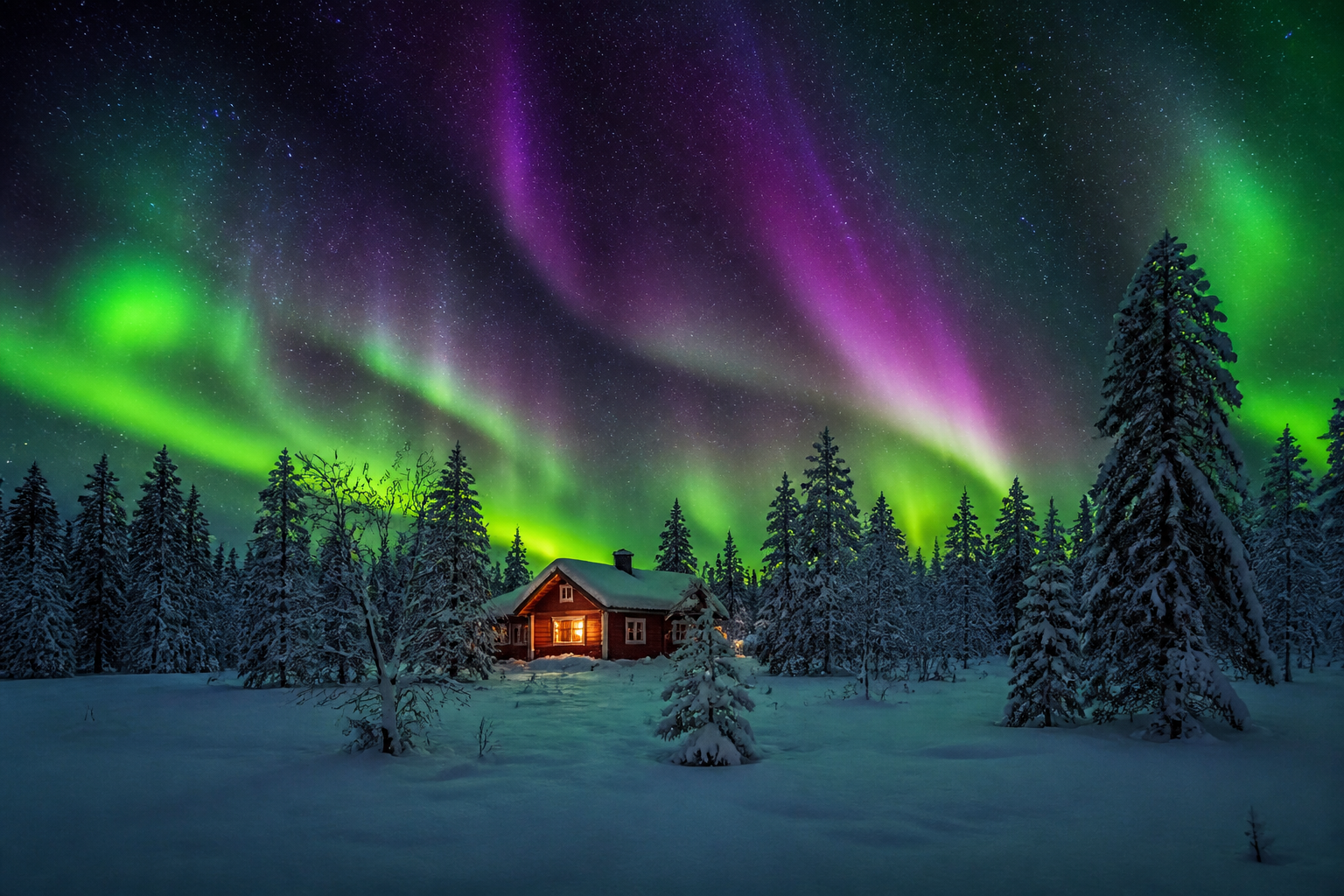
We see the question all the time: "What's the best aurora forecast app for Lapland?" It’s the digital equivalent of looking up at the sky and asking, "Will the magic happen tonight?" You’ve travelled all this way, you're wrapped in layers, and you're ready for the show. The last thing you want is to be staring at your phone, confused by a dozen different apps all telling you something different.
After years of guiding visitors and spending countless hours of our own staring at the northern sky, we've learned a crucial lesson: there is no single 'most accurate' app. Instead, the secret is knowing which tools to use and how to combine them. It's about building a complete picture, not just relying on one flashy number. Let's walk you through our personal toolkit for predicting the Northern Lights here in our home, Finnish Lapland.
It's Not Just About Kp-Index: What Really Matters
First, a quick science lesson that will put you ahead of 90% of other aurora hunters. Nearly every app will show you the Kp-index, a number from 0 to 9. It’s a simple measure of global geomagnetic activity. A higher number is better, right? Yes, but it's a terrible predictor on its own.
Here's what we actually look at:
- Bz (Interplanetary Magnetic Field): This is the single most important short-term indicator. When the Bz value is negative (southward), it opens a 'door' in Earth's magnetic field, allowing solar particles to stream in and create auroras. A sustained negative Bz (e.g., -5 nT or lower) is a very strong sign that things are about to get good.
- Solar Wind Speed: This is the speed of the particles hitting our atmosphere. Faster is better. Anything over 400 km/s is good, and when it pushes past 600-700 km/s, you can expect dynamic, fast-moving auroras.
- Density: The number of particles in the solar wind. Higher density means brighter lights. Think of it as the volume knob.
A forecast with a low Kp-index of 2 but a strong negative Bz and high wind speed is far more promising than a forecast with a Kp of 4 and a positive Bz. Understanding this is your first step to outsmarting the basic apps.
Our Go-To App: My Aurora Forecast & Alerts
This is probably the most popular aurora app, and for good reason. It’s user-friendly, has a clean interface, and provides a good all-in-one dashboard.
- Why we like it: It presents the key data (Kp, wind speed, Bz) clearly. The 'Viewing Probability' percentage is a nice, simple summary for beginners. The map showing the aurora oval is also helpful for visualizing how far south the lights might be visible. It’s a great starting point.
- The honest truth: Its push notifications can be a bit over-eager. We've received alerts for a "high chance" of auroras on completely cloudy nights. It's a global app, so its predictions aren't specifically tuned to local Finnish conditions. It’s a solid B+ student — reliable, but not always the top performer.
- Cost: Free with ads. A one-time payment of around €5 removes them and unlocks features like more frequent data updates.
The Local Champion: Aurora Alert Realtime
This is our secret weapon for accuracy within Finland. Developed by a Finnish space weather enthusiast, this app is specifically designed for our latitudes.
- Why we like it: It doesn't rely on global prediction models. Instead, it pulls data directly from magnetometers located across Finland (like in Sodankylä and Oulu). When these instruments detect a local magnetic disturbance, the app pings you. This means the alert you get is for something happening right now, right above you, not a general global forecast.
- The honest truth: The user interface is a bit dated compared to slicker apps like My Aurora Forecast. It’s also hyper-local; its alerts are gold in Rovaniemi or Saariselkä, but useless if you're in Iceland or Norway. We've found its alerts to be the most reliable trigger for grabbing our cameras and running outside.
- Cost: Free with ads, with a small fee (around €3) to remove them.
For the Data Nerds: SpaceWeatherLive
If you want to go straight to the source, the SpaceWeatherLive app (and website) is for you. This isn't an 'aurora forecast' app in the traditional sense; it’s a space weather data hub.
- Why we like it: It provides the raw, unfiltered data from NOAA and other space agencies. You get beautiful, real-time graphs for Bz, wind speed, density, and more. Once you learn to read these charts, you can make your own predictions with a high degree of accuracy. It's incredibly empowering.
- The honest truth: The learning curve is steep. If you don't know your Bz from your Bt, it will just look like a bunch of confusing squiggly lines. There are no friendly push notifications saying "Go outside now!" You have to do the interpretation yourself. We use this to confirm what the other apps are telling us.
- Cost: Free.
The Finnish Official Source: Auroras Now! Service
The Finnish Meteorological Institute (FMI) runs a service called Revontulet! (Auroras Now!). It's not a downloadable app but a subscription service via email and a website.
- Why we like it: It's as official as it gets. Similar to the Aurora Alert Realtime app, it's based on real-time measurements from Finnish soil. When the magnetic activity in Finland crosses a certain threshold, you get an email alert. It's simple, no-frills, and reliable.
- The honest truth: It's just a simple alert. There are no maps, no percentages, no long-term forecasts. It's a binary 'on/off' signal. You have to sign up on their website, and it feels a little less modern than an app. Still, for a simple, reliable ping, it's excellent.
- Cost: Free.
Don't Forget the Weather: Your Cloud Forecast is Key
This might be the most important "app" in your toolkit. You could have a G5 geomagnetic storm (the strongest possible), but if there's a thick blanket of clouds, you will see absolutely nothing. Zero. Zilch.
We always check the cloud cover forecast with the same intensity as the aurora forecast. Our preferred services are:
- Yr.no: The Norwegian Meteorological Institute's service. We find its cloud cover predictions (shown as percentages) to be incredibly accurate for Lapland.
- Foreca: A Finnish company whose forecasts are also very reliable for our region.
Look for clear sky forecasts with 0-20% cloud cover. Check the hour-by-hour prediction. Sometimes a window of clear sky for just one hour between 10 PM and 1 AM is all you need. For more detailed insights, the Finnish Meteorological Institute provides local weather information that can be very helpful.
The Human Touch: Why Facebook Groups Beat Algorithms
No app can compete with thousands of pairs of human eyes. This is our ultimate local tip. Join a Finnish aurora-hunting Facebook group. The biggest and best is "Aurora Alert FINLAND."
- Why we like it: People post photos in real-time from all over Finland. You'll see a post from someone in Utsjoki saying "It's starting!" followed by someone in Levi saying "Faint green glow to the north!" This is ground truth. It tells you exactly what's happening and where. Members also share tips, camera settings, and encouragement. It's a wonderful community.
- The honest truth: You'll get a lot of notifications. During a good aurora storm, your phone will be buzzing constantly. You also need to be able to sift through the posts to find ones relevant to your location.
- Cost: Free.
A Visual Check: Using Lapland Webcams
Before you spend an hour getting into your thermal gear, do a quick visual check. Many hotels, ski resorts, and tourism boards across Lapland operate live webcams. Search for webcams in northern locations like Kilpisjärvi, Utsjoki, or Saariselkä.
If you see a faint green arc on a webcam 200km north of you, and the cloud forecast for your location is clear, you know it's time to get ready. It’s a simple, effective way to confirm that there's actually something to see. For a deeper dive into optimal conditions and planning your trip, consider checking out our guide on the best time to see Northern Lights in Lapland. You can also explore various Lapland activities and tours to enhance your winter adventure. For general information about the region, consider visiting the official Visit Finland website. To complete your trip, check hotel availability in Lapland.
Book your Lapland trip
- 🏨 Stay — Compare hotels, cabins and glass igloos in Lapland
- 🦌 Do — Browse husky, reindeer and aurora tours
Some links on this page are affiliate links. Booking through them costs you nothing extra and helps keep Lapland Buddy free.
Usein kysyttyä
What Kp-index do I need to see auroras in Lapland?
Honestly, you can often see good auroras in Lapland with a Kp-index as low as 2, as long as other conditions like a negative Bz and clear skies are present. Because we are already inside the arctic circle, we don't need a massive global storm. Focus more on Bz, wind speed, and cloud cover.
Are paid aurora apps worth it?
In our experience, paying a few euros to remove ads is worth it for a cleaner experience, but the free versions of the best apps (like My Aurora Forecast and Aurora Alert Realtime) provide all the essential data you need. You don't get a more accurate forecast by paying more; you just get convenience.
What time of night is best for aurora hunting?
The prime time for auroras is generally between 10 PM and 2 AM local time. This is when the part of Earth you're on is facing away from the sun and is best aligned with the geomagnetic tail where the activity happens. However, we've seen fantastic displays as early as 7 PM and as late as 4 AM, so be prepared to be patient.
Can I see the Northern Lights from Rovaniemi?
Absolutely! While [Rovaniemi](/place/rovaniemi) has some light pollution, you can easily see the Northern Lights from there. We recommend heading to the shores of the Ounasjoki or Kemijoki rivers, or the top of Ounasvaara hill. Just a 10-15 minute drive out of the city center will dramatically improve your view.
How do I combine all these tools?
Here's our nightly workflow: 1. Check a long-range app like My Aurora Forecast in the afternoon. 2. Check the cloud forecast on Yr.no. If it's clear, we proceed. 3. As evening approaches, we monitor SpaceWeatherLive for a negative Bz. 4. We keep an eye on Facebook groups for real-time sightings. 5. If we get an alert from Aurora Alert Realtime, we know it's go-time!
Lisää kysymyksiä?
Kysy Buddylta suoraan — ilmaisia ja välittömiä vastauksia Rovaniemestä ja Lapista.
Avaa Lapland Buddy